Choosing between a beaker bong and a straight tube bong can change everything from hit smoothness to stability and cleaning time. Many buyers focus on appearance or size without considering how shape affects water capacity, airflow, filtration, and daily use. This beaker vs straight tube bong comparison explains the key differences. You will also learn which design suits beginners, experienced users, home setups, and portable sessions.
1. Beaker vs Straight Tube Bong: What Is the Difference?
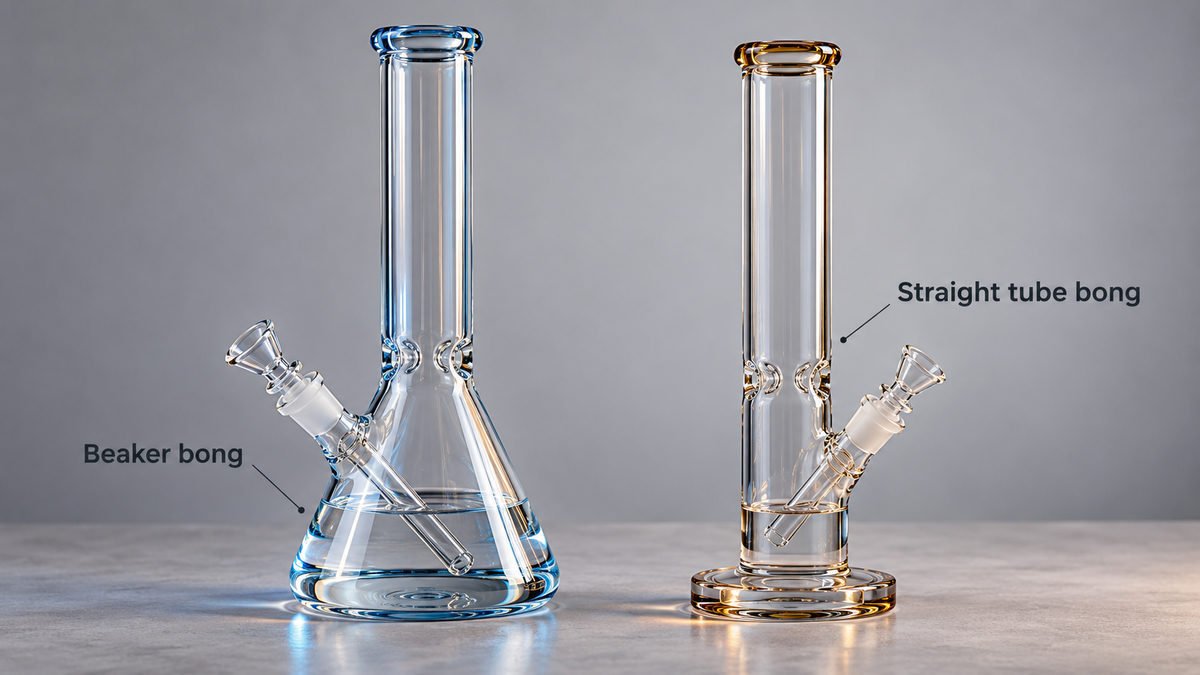
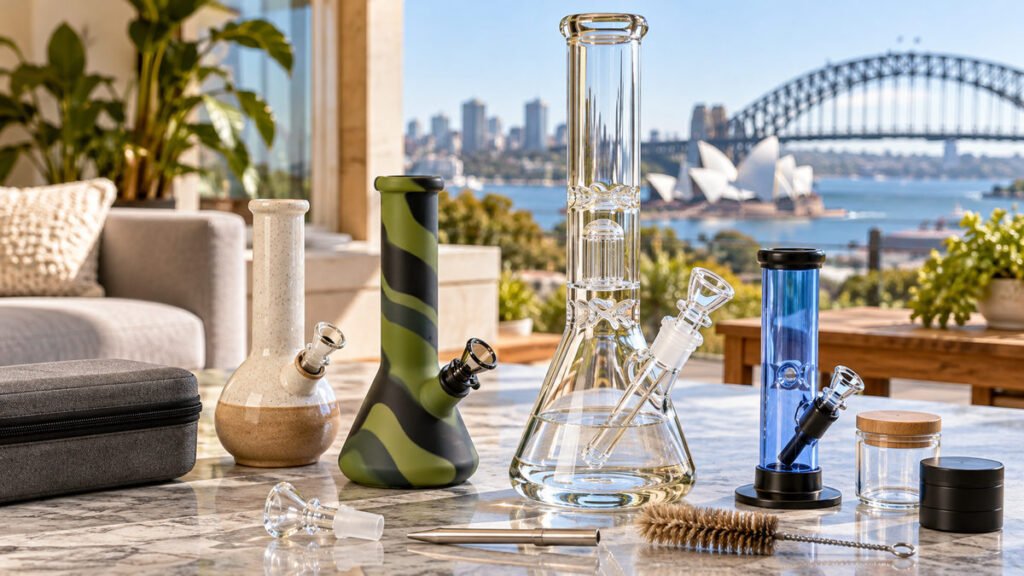
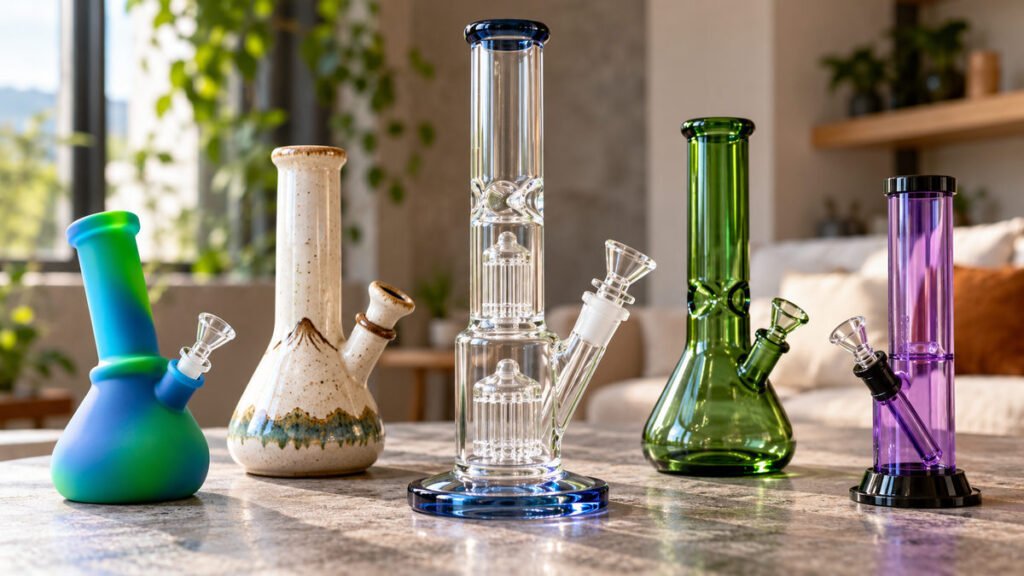
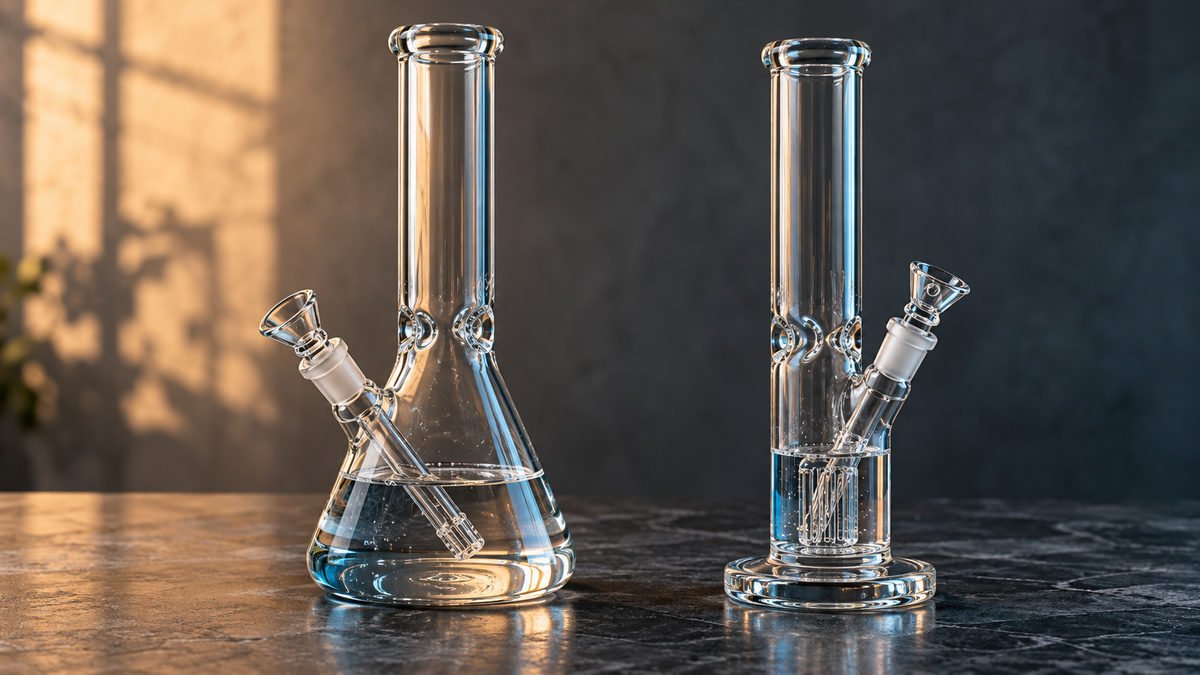
A beaker bong has a wide, conical base that resembles laboratory glassware. The base holds water, while a narrower neck rises towards the mouthpiece. This design gives the bong a broad footprint and a lower centre of gravity.
Meanwhile, a straight tube bong uses a cylindrical chamber with a consistent diameter from the base to the mouthpiece. Its shape looks simpler and usually creates a more direct path for smoke. Straight tubes often use a separate flat base for support.
The main difference involves base width, chamber shape, water capacity, and overall balance. A beaker bong often holds more water than a similarly tall straight tube. However, its wider chamber may also hold more smoke before clearing.
In contrast, a straight tube usually has a narrower smoke path and a more immediate draw. Therefore, many users find straight tubes easier to clear quickly. A beaker bong may feel more spacious and forgiving during longer sessions.
Shape also affects storage and handling. Beaker designs need more shelf space, while straight tubes can fit into narrower cupboards. However, a narrow and tall bong may need more careful placement.
Before choosing, consider these practical factors:
- Hit smoothness and cooling potential
- Water filtration and percolator options
- Stability and glass thickness
- Cleaning access and maintenance time
- Portability and storage space
- Price, craftsmanship, and replaceable parts
Still, shape does not determine performance alone. The downstem, water level, percolator, ice catcher, glass thickness, and your draw technique matter greatly. Water pipes work by drawing smoke through water, which can cool smoke and filter some particles, according to this overview of bong design and function.
2. Beaker Bong vs Straight Tube: Performance, Smoothness, and Airflow
Which design produces smoother hits?
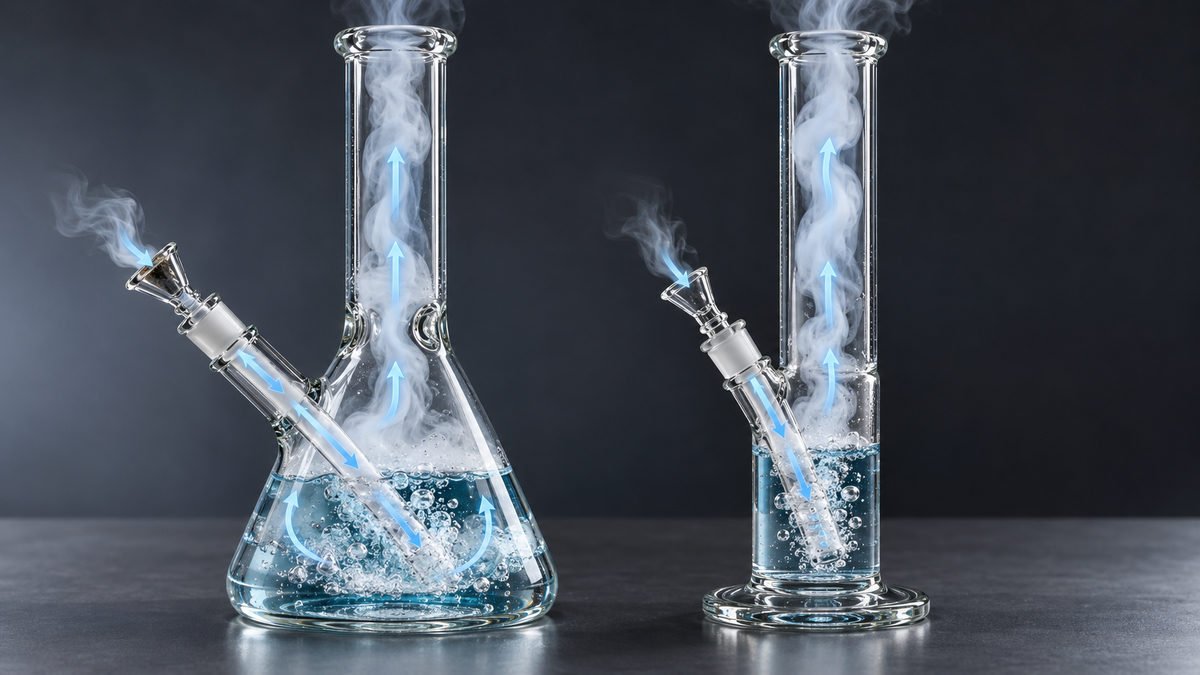
A wider beaker base can hold more water, creating greater potential for cooling and filtration. More water contact may help soften the feel of a larger draw. However, extra water does not automatically create a smoother bong.
The downstem must sit at the correct depth. The water level must also cover the diffuser without creating excessive drag. Therefore, a well-tuned beaker often performs better than a poorly filled one.
Straight tube bongs usually create direct, fast airflow. Their narrow chamber can make the draw feel immediate and responsive. Additionally, a quality diffuser downstem can provide excellent bubbling inside a smaller chamber.
In practice, a straight tube with a showerhead, inline, or matrix percolator may feel just as smooth. The filtration system often matters more than the outer silhouette. Therefore, compare the downstem and percolator before judging shape alone.
Are straight tube bongs more powerful?
Not necessarily. Perceived power depends on bowl size, airflow restriction, chamber volume, water depth, and draw technique. A straight tube may feel stronger because it clears quickly and delivers smoke directly.
Meanwhile, a large beaker can hold more smoke before clearing. That can create a bigger session, but it may require stronger lungs and better timing. A larger chamber does not automatically mean better performance.
Clearing speed usually favours the straight tube. Smoke travels through a narrower and more direct chamber, so users can often clear it quickly. Beaker bongs may take longer because their wider bases hold greater smoke volume.
Shape affects the experience, but accessories often create the larger difference. A basic beaker with a poor downstem may feel harsher than a simple straight tube with excellent diffusion. Therefore, focus on the complete setup rather than the outline alone.
3. Water Filtration, Ice Catchers, and Percolator Compatibility
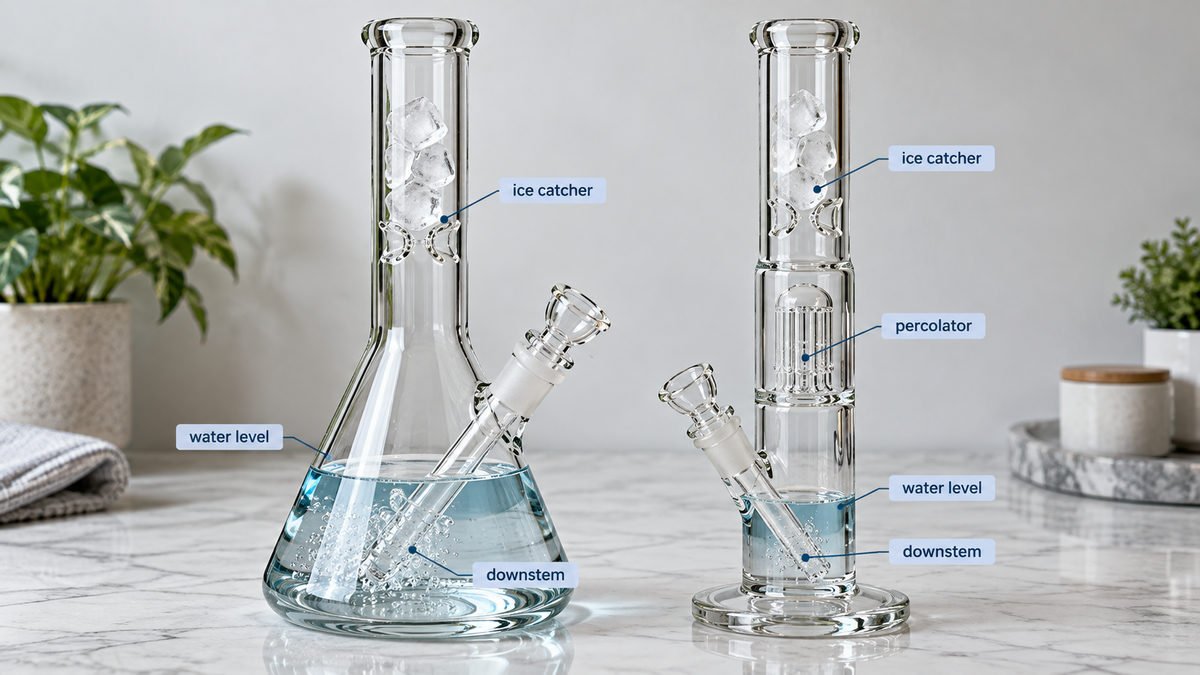
Beaker bongs generally hold more water than similarly tall straight tube bongs. Their wide bases provide extra room for water and smoke movement. This larger volume can increase cooling potential during longer draws.
However, more water can create problems when the level goes too high. Excess water may cause drag, splashback, or an uncomfortable draw. Therefore, add water gradually and test the airflow before using the bong.
Straight tube bongs can still provide excellent water filtration. A diffuser downstem breaks smoke into smaller bubbles inside the chamber. A multi-arm percolator can create even more water contact without needing a wide base.
Common percolator styles include:
- Honeycomb percolators for dense bubbling
- Tree percolators with multiple arms
- Showerhead percolators for downward diffusion
- Inline percolators for horizontal smoke distribution
- Matrix percolators for broad bubbling patterns
Ice catchers can support cooling in both designs. They hold ice above the water line, allowing smoke to pass over chilled surfaces. However, ice should support proper water filtration rather than replace it.
Beaker bongs often offer more chamber space for ice and larger percolators. Straight tubes can also work well when the ice catcher sits high enough. Therefore, accessory placement matters more than the bong’s basic shape.
Extra filtration usually increases smoothness potential. However, it can also restrict airflow and make cleaning more difficult. Resin collects inside small holes, arms, and narrow passages.
Choose a simple downstem setup if you value easy cleaning and reliable airflow. Select a complex filtration system when you accept more maintenance for additional diffusion. Beginners often benefit from starting simple and upgrading later.
4. Stability, Durability, and Bong Size Comparison
A beaker bong is usually more stable because its wide base lowers the centre of gravity. The broad footprint reduces the chance of tipping during regular use. This advantage matters on crowded desks, benches, and coffee tables. Compare heights in our bong sizes guide.
Straight tube bongs can remain stable when they use a heavy base. However, narrow bases and taller profiles make some models more vulnerable to accidental knocks. Therefore, always check the base construction before buying.
The least likely design to tip is usually a moderately sized beaker with a thick, weighted base. Still, placement matters just as much. Keep the bong on a level surface away from pets, children, edges, and loose cables.
Durability depends on more than shape. Look for suitable glass thickness, clean joints, reinforced necks, and a strong base connection. Thick borosilicate glass can improve resistance to everyday heat and handling.
However, a thick straight tube can outlast a thin beaker bong. Poor joints and delicate necks can weaken either design. Therefore, inspect the entire piece instead of relying on the word “beaker”.
Large bongs offer more water and smoke capacity. They may provide greater cooling potential, but they need more storage space and careful water adjustment. Larger chambers can also demand stronger lungs.
Small bongs are easier to carry, store, and clean. They usually clear faster and create less breakage risk during transport. However, their smaller chambers may provide less cooling and smoke capacity.
For most buyers, a moderate-sized bong offers the best balance. It can provide useful water capacity without becoming awkward. Additionally, moderate designs usually fit more shelves, cases, and cleaning tools.
5. Cleaning, Maintenance, Portability, and Everyday Use
Which bong is easier to clean?
Beaker bongs have a wide base that can provide better access during rinsing. You can often see residue across the lower chamber more easily. However, the larger water area may collect more residue over time.
Straight tube bongs usually have a simple cylindrical interior. Therefore, rinsing and draining can feel quicker. Their narrow shape may still create challenges around the joint and downstem opening.
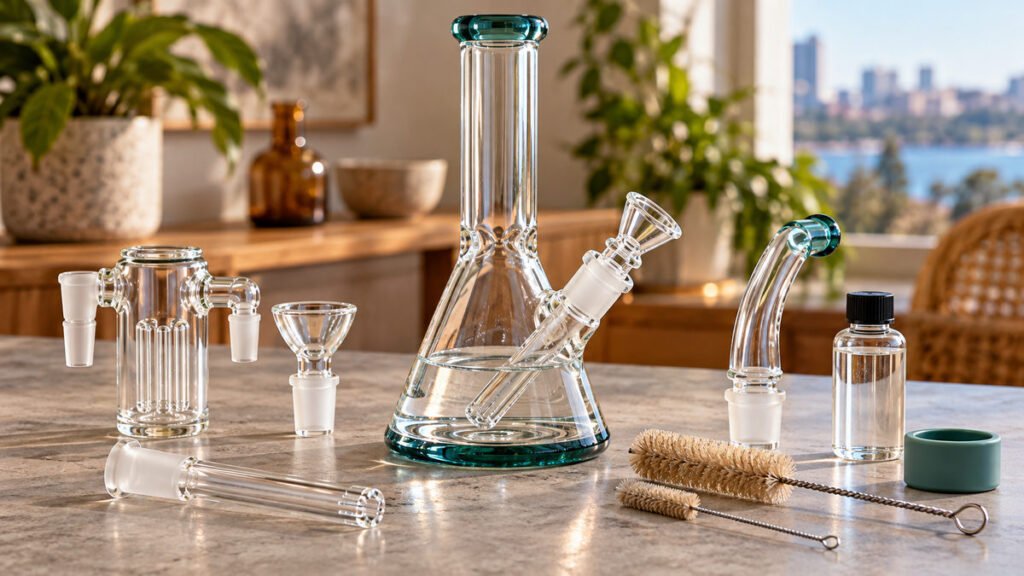
Percolators, ash catchers, and narrow joints increase cleaning time in either design. Small holes can trap resin, ash, and stale water. Additionally, removable parts require separate rinsing and careful handling.
For routine care, change the water regularly and rinse the chamber after use. Use isopropyl alcohol with coarse salt where appropriate for glass surfaces. Always follow product guidance and keep cleaning products away from children and pets.
Clean removable downstems, bowls, and ash catchers separately. A cotton swab can help reach joint areas and small openings. Therefore, regular light cleaning usually feels easier than occasional deep cleaning.
Which bong is easier to transport?
Smaller straight tube bongs are often easier to transport because they have narrow footprints. They can fit into compact protective cases and smaller storage spaces. Their simpler interiors may also reduce the number of parts to pack.
Beaker bongs need more room because of their wide base. They also require careful packing around the lower chamber. However, their broad base can make them easier to use once you reach your destination.
Travel creates risks around exposed glass joints, removable downstems, and loose bowls. Empty the bong fully before moving it. Then wrap each component separately inside a purpose-built protective case.
For storage, compare height, base width, glass thickness, and accessory count. A compact bong with fewer attachments often provides the easiest everyday routine. Meanwhile, a larger setup suits a fixed home location.
6. Side-by-Side Comparison: Advantages, Drawbacks, and Value
| Feature | Beaker Bong | Straight Tube Bong |
|---|---|---|
| Shape | Wide, conical base with a narrower neck | Cylindrical chamber with a consistent diameter |
| Stability | Usually stronger because of the broad base | Depends heavily on the base weight and width |
| Water capacity | Usually higher in similarly tall models | Often lower, especially in narrow designs |
| Filtration potential | Large chamber suits water and added percolators | Excellent with quality diffusers and percolators |
| Hit smoothness | Strong cooling potential with correct water levels | Can feel equally smooth with effective filtration |
| Clearing speed | May take longer because of larger smoke volume | Often clears quickly through a direct chamber |
| Portability | Wide base needs more packing space | Compact options are easier to carry |
| Cleaning | Wide base helps access, but holds more residue | Simple chamber often rinses quickly |
| Accessory compatibility | Good space for ice and larger percolators | Works well with compact filtration setups |
| Durability | Depends on glass thickness and joint quality | Depends on glass thickness and base construction |
| Typical buyer | Home users wanting stability and cooling potential | Users wanting speed, simplicity, and storage convenience |
Beaker bong benefits include strong stability, greater water capacity, and generous filtration potential. They suit longer sessions and users who prefer a comfortable home setup. However, the wide footprint can reduce portability.
Beaker models may also clear more slowly and require more water management. Their larger chambers can collect more residue. Therefore, they reward users who value performance over compact storage.
Straight tube bong benefits include direct airflow, fast clearing, compact storage, and simple maintenance. They work well with basic downstem setups. Additionally, their shape suits users who move equipment between locations.
Their drawbacks include greater tipping risk and lower water capacity in some models. Without added filtration, a straight tube may offer less cooling. However, a good diffuser can address much of that difference.
Value depends on glass thickness, craftsmanship, downstem quality, percolator design, and included accessories. A simple, well-built bong usually offers better value than a cheap model with unnecessary complexity.
Prioritise durable glass, replaceable downstems, reliable joints, and accessible cleaning points. Decorative features can look appealing, but they rarely matter as much during daily use.
7. Which Bong Should I Buy? Recommendations by User and Smoking Style
Choose a beaker bong if you value stability
Choose a beaker bong if you want a stable home setup with greater water capacity. Its wide base suits users who dislike narrow, easily disturbed pieces. The larger chamber can also provide stronger cooling potential with the correct water level. See our top picks in best bongs in Australia 2026.
A moderately sized beaker can suit beginners because it feels stable and forgiving. However, keep the design simple at first. A basic downstem makes water levels, airflow, and cleaning easier to understand.
Choose a straight tube if you value speed and portability
Choose a straight tube if you want direct airflow, fast clearing, and compact storage. Its cylindrical chamber can make the setup easier to rinse. Smaller models also suit occasional use and limited living spaces.
A simple straight tube can be beginner-friendly because it has fewer complicated parts. However, check the base carefully before buying. A heavy, stable base can reduce tipping concerns.
Experienced users may prefer either shape for customisation. Beaker bongs provide room for ice catchers, ash catchers, and larger percolators. Straight tubes suit users who prefer modular accessories and quick airflow adjustments.
Use these simple decision rules:
- Choose a beaker for stability, water capacity, and cooling potential.
- Choose a straight tube for speed, direct airflow, and portability.
- Choose a smaller model for limited storage or occasional use.
- Choose a larger model for stationary setups and greater smoke capacity.
- Choose simple filtration for easier cleaning and reliable airflow.
Do beaker bongs hold more water? Usually, yes, because their wider bases provide more chamber space. Are straight tube bongs easier to clear? Often, yes, because their narrower chambers support faster smoke movement.
Before buying, check the height, base width, glass thickness, joint size, and downstem design. Also consider the ice catcher, percolator, cleaning access, accessory count, and total budget. Finally, confirm that your intended use complies with Australian laws and product instructions.
Conclusion
Beaker bongs usually provide better stability, greater water capacity, and strong cooling potential. Straight tube bongs typically offer faster clearing, direct airflow, easier storage, and simpler maintenance.
The best choice depends on your priorities. Choose a beaker when stability and smoother potential hits matter most. Select a straight tube when portability, speed, and easy cleaning fit your routine better.
Compare durable glass models, check the downstem and filtration features, and choose a shape that suits your space and experience level. You can explore relevant water pipes and smoking accessories through Sweet Puff Australia, then match the design to your preferred setup and cleaning habits.