
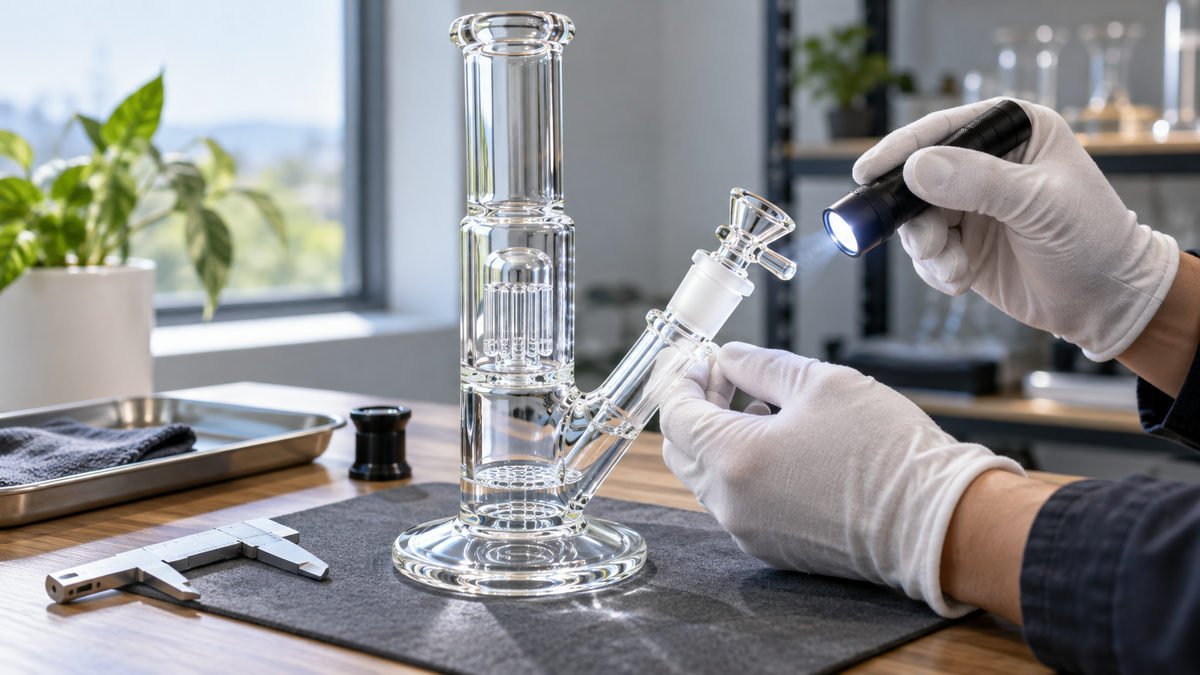
A bong can look impressive in product photos yet hide weak glass, poor welds, unstable geometry, or restricted airflow. Learning how to inspect glass bong quality helps you avoid fragile construction, hidden defects, and designs that become difficult to clean. This guide covers materials, craftsmanship, stability, airflow, pricing, seller information, maintenance, and practical safety checks before you buy.
1. How to Inspect Glass Bong Quality: The Core Buying Criteria
Material quality
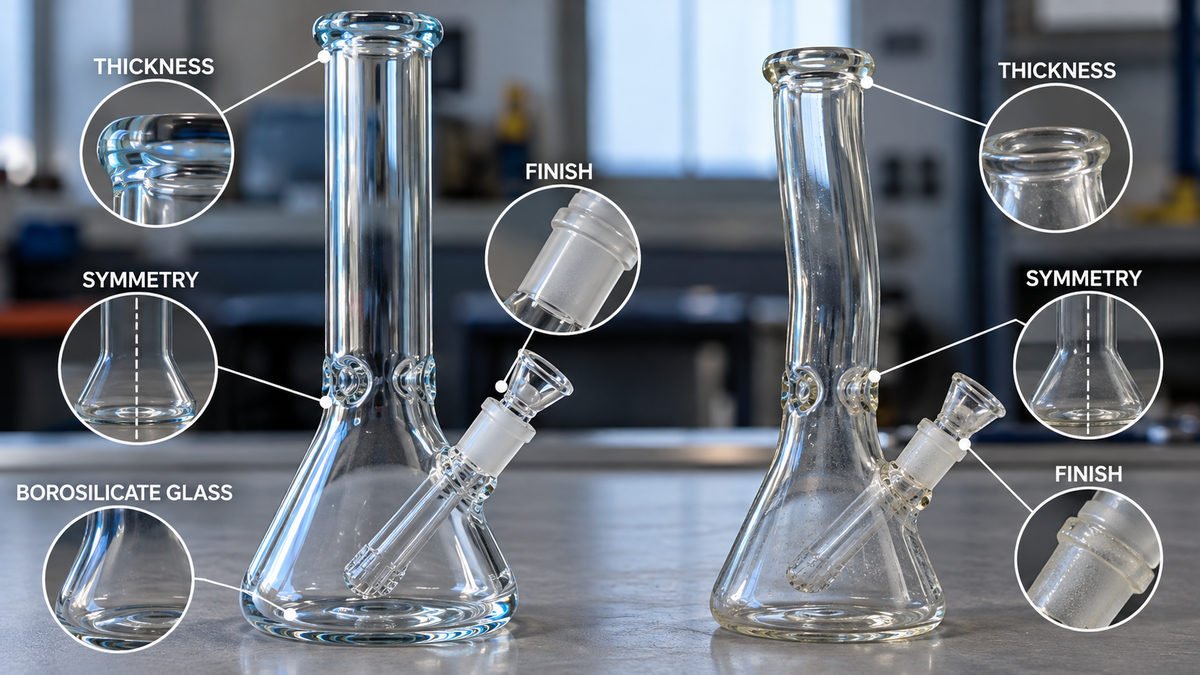
Start by confirming the glass type. Laboratory-grade borosilicate glass generally offers better thermal resistance, chemical stability, and thermal-shock resistance than unspecified soda-lime or low-quality glass. Wall thickness matters; see our guide to thick glass bongs.
However, borosilicate glass still requires careful handling. Sudden temperature changes can create stress, even when the glass has a low expansion rate. You can read more about its properties through SCHOTT’s borosilicate glass information.
Be cautious when a listing simply says “premium glass” without naming the material. A trustworthy seller should explain the glass type clearly. If the specification remains vague, treat that uncertainty as a buying risk.
Construction and finish
Next, examine the bong as one complete structure. Look for consistent wall thickness, smooth surfaces, polished openings, balanced proportions, and accurate alignment between the base, neck, joints, and chamber.
Additionally, hold the piece carefully if you can inspect it in person. Quality glass often feels solid without becoming unnecessarily heavy. Excessive weight may indicate thick glass, but it can also reflect bulky or poorly controlled construction.
Thickness and durability
Thicker glass usually improves impact resistance, especially around the base, joints, and main chamber. Nevertheless, thickness alone does not prove quality. Poor annealing, uneven walls, sharp transitions, and weak welds can still cause failure.
Consider the intended setting. A tall, elaborate bong may benefit from reinforced sections and a broader base. Meanwhile, a compact piece may use moderate thickness while remaining easier to handle and store.
Craftsmanship signals
Careful handmade glasswork usually shows uniform curves, controlled shaping, clean transitions, and deliberate finishing. Minor artistic variation may appear, but functional areas should remain precise.
In contrast, rushed production may reveal lumpy welds, inconsistent curves, cloudy sections, rough openings, or misaligned attachments. Therefore, inspect the areas connecting separate glass components first. These points often reveal more than decorative features.
Common red flags
- Extremely thin walls with no clear construction details.
- Vague descriptions that omit the glass type.
- Excessive visual distortion through the chamber.
- Rough edges, uneven surfaces, or unfinished openings.
- Unusually low pricing without a reasonable explanation.
- Decorative features that appear unsupported or fragile.
2. Inspect Joints, Welds, Openings, and Manufacturing Defects
Joints and welds
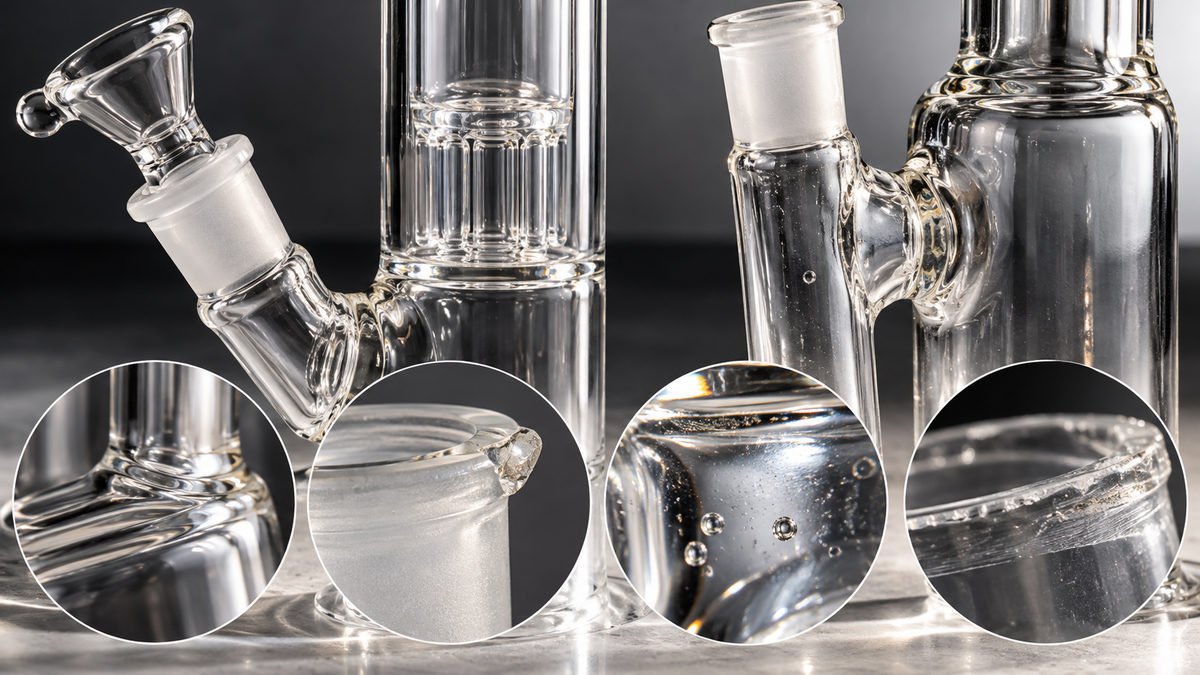
Joints and welds deserve close attention because they connect the bong’s most important components. Inspect the downstem joint, bowl joint, chamber connections, and welded transitions from several angles. Check fit with our guide to bong joint sizes explained.
A strong weld should look smoothly fused rather than abruptly attached. The glass distribution should appear even, with no thin crescent, deep groove, or sharp stress point around the connection.
Furthermore, check whether each joint sits squarely against the body. Misalignment can make removable parts sit at an angle. It may also create uneven seals, awkward cleaning access, or excessive strain during use.
Defect inspection
Run your eyes slowly across the entire piece. Look for cracks, chips, bubbles, stress marks, cloudy zones, pinholes, warped sections, uneven rims, and sharp edges.
Small decorative bubbles may occur in some handmade designs. However, bubbles near joints, rims, or thin transitions deserve more caution. They can indicate inconsistent heating, trapped contamination, or local weakness.
Also inspect the base where it meets the main chamber. A distorted base can make the bong unstable. Similarly, a slightly chipped rim can become uncomfortable and may worsen during cleaning.
Mouthpiece and openings
A comfortable mouthpiece should have a smooth, rounded lip. It should feel even around the entire opening, without sharp edges, rough interior glass, thin spots, or visible contamination.
Therefore, inspect the mouthpiece under bright light. Look for hairline fractures and rough finishing around the inner edge. A polished opening improves comfort and reduces the chance of small cuts during handling.
Seals and fit
Removable parts should seat securely without excessive looseness, rocking, grinding, or visible gaps. If the store permits inspection, gently fit the bowl and downstem without forcing them.
A good fit should feel controlled rather than tight and abrasive. Excessive movement may create leaks or place stress on the joint. Conversely, a part that grinds against the joint may damage the contact surface over time.
Additionally, check whether the downstem extends into the chamber correctly. It should not press against the base or sit so high that it cannot function properly.
Handmade variation versus poor production
Handmade glass can include slight differences in curves, colour, or decorative details. Those variations do not automatically indicate poor quality.
Nevertheless, functional areas should remain symmetrical, sealed, smooth, and structurally sound. Artistic character is acceptable, but cracks, uneven rims, unstable bases, and weak welds are not artistic features.
3. Evaluate Bong Stability, Base Design, and Safety Features
Base and centre of gravity
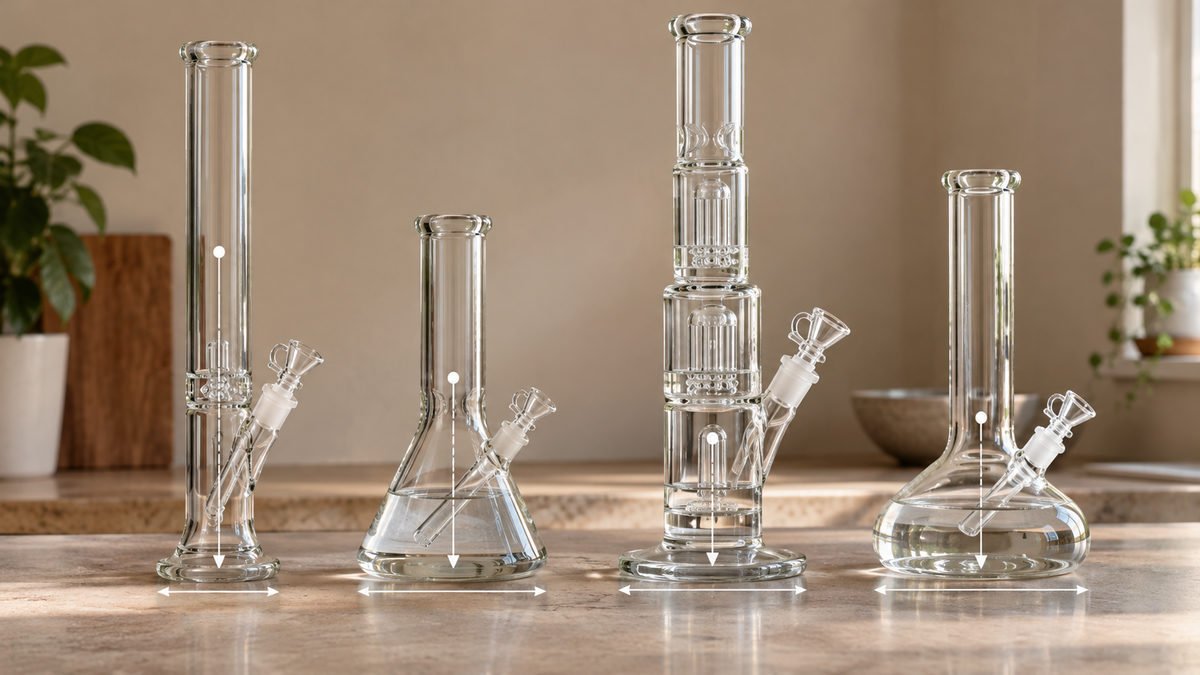
A broad, level base helps reduce accidental tipping. This matters particularly with tall bongs, multi-chamber designs, and pieces carrying several accessories.
Ideally, the bong should keep its centre of gravity close to the base. A narrow base combined with a long neck can make the piece unstable. Heavy attachments near the top can make that problem worse.
Perform a physical stability test
If you are shopping in person, ask to place the bong on a flat, stable surface. Watch for rocking, uneven contact, or a base that touches only at a few points.
Next, apply gentle pressure near the upper body. Do not push hard or test the glass aggressively. The piece should remain planted without sliding, wobbling, or leaning noticeably.
Also test the piece with its included accessories fitted. A bowl, ash catcher, or other attachment can shift the balance. Therefore, judge the complete setup rather than the empty bong alone.
Structural safety features
Look for stable chamber geometry, reinforced connection points, smooth edges, and secure ice catchers. Avoid designs with exposed protrusions that could catch on clothing or break during ordinary handling.
Complexity can increase cleaning demands and breakage risk. For that reason, choose decorative or functional additions only when they contribute meaningful value.
Handling and storage
Carry the bong by its base and main body rather than by the neck or removable parts. Keep it away from crowded table edges, pets, children, and areas with frequent movement.
Meanwhile, store removable parts separately when appropriate. Use a stable, padded location that prevents the chamber from contacting hard surfaces.
Finally, follow local laws and use glass equipment only where permitted. Keep it away from unsafe heat sources and never leave it accessible to children or pets.
4. Assess Percolator Quality, Airflow, Downstems, and Bowls
Percolator effectiveness
A quality percolator should create consistent diffusion without making the draw excessively restrictive. It should also avoid fragile, unsupported structures and difficult-to-clean dead zones. See our bong downstem guide for fit and diffusion.
More diffusion does not automatically mean better performance. A highly complex percolator may produce many bubbles yet create stronger resistance, splashback, and residue buildup.
Therefore, assess the whole airflow path. The best design balances diffusion, smooth resistance, durability, cleaning access, and replacement practicality.
Compare common designs
- Showerhead percolators: Usually offer balanced diffusion and relatively straightforward cleaning.
- Tree percolators: Can create substantial diffusion, but their arms may increase fragility and cleaning complexity.
- Honeycomb percolators: Often produce vigorous bubbling, although they may feel restrictive and collect residue quickly.
- Inline percolators: Can provide efficient diffusion with a low profile, but their internal slits require careful cleaning.
- Diffused downstems: Offer a practical balance between simplicity, airflow, and replaceability.
In contrast, a simpler downstem may suit someone who values durability and easy maintenance. A complex percolator may suit buyers who accept extra care for stronger diffusion.
Evaluate airflow
When store testing is permitted, check for a smooth draw and balanced resistance. The airflow should feel open enough for comfortable use without becoming uncontrolled.
Watch the water movement during the test. Stable bubbling suggests a clear pathway, while irregular chugging may indicate restricted openings, poor alignment, or an unsuitable water level.
Additionally, listen for unusual whistling or gurgling. These sounds can point to narrow passages, imperfect seals, or water contacting the wrong internal surfaces.
Set the water level correctly
The correct water level should cover the diffusion openings. However, it should leave enough clearance to reduce splashback and prevent water reaching the mouthpiece.
Water levels vary between designs. Ask whether the seller provides a recommended fill level, especially for multi-chamber pieces or unusual percolator layouts.
Inspect downstems and bowls
Check joint compatibility, secure seating, clean air intake holes, and the downstem’s overall thickness. Removable downstems usually simplify replacement and cleaning.
Fixed downstems can offer a clean appearance, but repairs may become more difficult. Therefore, confirm how the design handles replacement if the downstem becomes damaged.
The bowl should sit securely and include a practical handle. Inspect its walls, rim, airflow opening, and connection point. Also ask whether replacement bowls remain available.
Understand joint size and angle
Common joint sizes and angles matter because they determine accessory compatibility. They also affect future replacement options and the range of bowls or downstems you can use.
Before buying, confirm the joint diameter and whether it uses a straight or angled connection. A small measurement mistake can make otherwise suitable accessories unusable.
5. Compare Price, Brand Reputation, and Online Listings
Judge price against value
Premium pricing may reflect borosilicate glass, thicker construction, skilled craftsmanship, reliable diffusion, artist work, warranty coverage, or replacement-part support. Compare sellers in our guide on where to buy bongs online in Australia.
However, expensive glass bongs are not automatically better. Compare the materials, engineering, finish, stability, service, and documented specifications before judging the price.
A cheaper model may offer excellent value when it has clear construction details and a simple, serviceable design. Conversely, a heavily decorated piece may cost more without improving durability or airflow.
Research the seller and brand
Check material specifications, manufacturing details, warranty terms, return policies, customer service, and product history. Reliable sellers should answer practical questions without avoiding specific details.
Additionally, read reviews that discuss long-term ownership. A review written after several months may reveal leaks, breakage, cleaning difficulty, packaging problems, or unavailable replacement parts.
Use an online inspection checklist
Request clear photos of the joints, welds, base, mouthpiece, percolator, and any visible defects. Product images should show the actual construction rather than only polished promotional angles.
- Verify the glass type and stated dimensions.
- Confirm the joint size, angle, and included parts.
- Ask how the seller protects glass during shipping.
- Read the return conditions before ordering.
- Check whether shipping insurance applies to breakage.
- Request clarification about marks, bubbles, or cosmetic variation.
Most importantly, avoid relying only on star ratings. Detailed feedback about airflow, leaks, packaging, cleaning, consistency, and replacement parts offers much stronger buying guidance.
6. Cleaning, Maintenance, and the Final Glass Bong Buying Checklist
Cleaning and maintenance
Regular cleaning helps preserve airflow and makes new defects easier to identify. Residue can hide chips, cracks, cloudy areas, and damaged joints. Combine these checks with our glass bong buying guide.
Begin with a warm-water rinse and use a suitable cleaning solution for the glass. Follow the product instructions, remove residue patiently, and avoid sudden temperature changes.
Never move a very hot piece directly into cold water. Allow it to return towards room temperature first. This reduces thermal stress and makes handling safer.
Safe cleaning practices
Inspect the glass before and after cleaning. Handle delicate percolators carefully, especially when pouring out water or removing trapped residue.
Furthermore, avoid abrasive tools that can scratch internal surfaces. Use appropriate brushes, flexible cleaning tools, and gentle movement around narrow chambers.
After cleaning, check that joints remain smooth and removable parts still seat correctly. A sudden change in fit may indicate damage or accumulated residue.
In-store buying checklist
- Confirm borosilicate glass and suitable wall thickness.
- Check weight, symmetry, curves, and surface finish.
- Inspect welds, joints, openings, rims, and mouthpiece.
- Look for cracks, chips, bubbles, cloudiness, and stress marks.
- Test the base for rocking and poor stability.
- Assess percolator bubbling and airflow when permitted.
- Confirm bowl fit, downstem seating, and joint compatibility.
- Ask about replacement parts and future servicing.
Online buying checklist
- Read detailed specifications rather than vague product claims.
- Research the seller’s reputation and customer service.
- Confirm warranty, returns, packaging, and shipping protection.
- Check accurate dimensions, joint size, and included accessories.
- Request clear photos of functional areas and possible defects.
- Read reviews about leaks, breakage, airflow, cleaning, and replacements.
Make the final decision
Choose the most stable, structurally sound, serviceable, and appropriately priced model. The most elaborate design may create more maintenance and breakage risk.
Therefore, prioritise verified material information, smooth construction, secure joints, balanced airflow, and accessible replacement parts. A simpler bong with excellent fundamentals often provides the better long-term purchase.
Conclusion
High-quality glass bong evaluation depends on more than appearance. Buyers should verify borosilicate glass, suitable thickness, smooth welds, defect-free surfaces, stable geometry, functional airflow, compatible removable parts, and effective percolation.
Additionally, credible seller information, clear return terms, practical maintenance requirements, and replacement support deserve equal attention. Use the inspection checklists before purchasing, then compare several models against the same criteria.
Choose a stable, well-finished bong with clear specifications and dependable support. For product options and related glass accessories, visit Sweet Puff Australia and apply the same inspection standards before buying.

Comment (1)
[…] For anyone still researching where to buy bongs online in Australia, a short checklist can make retailer comparisons more consistent and reduce avoidable purchasing problems. Before you pay, learn how to inspect glass bong quality. […]