
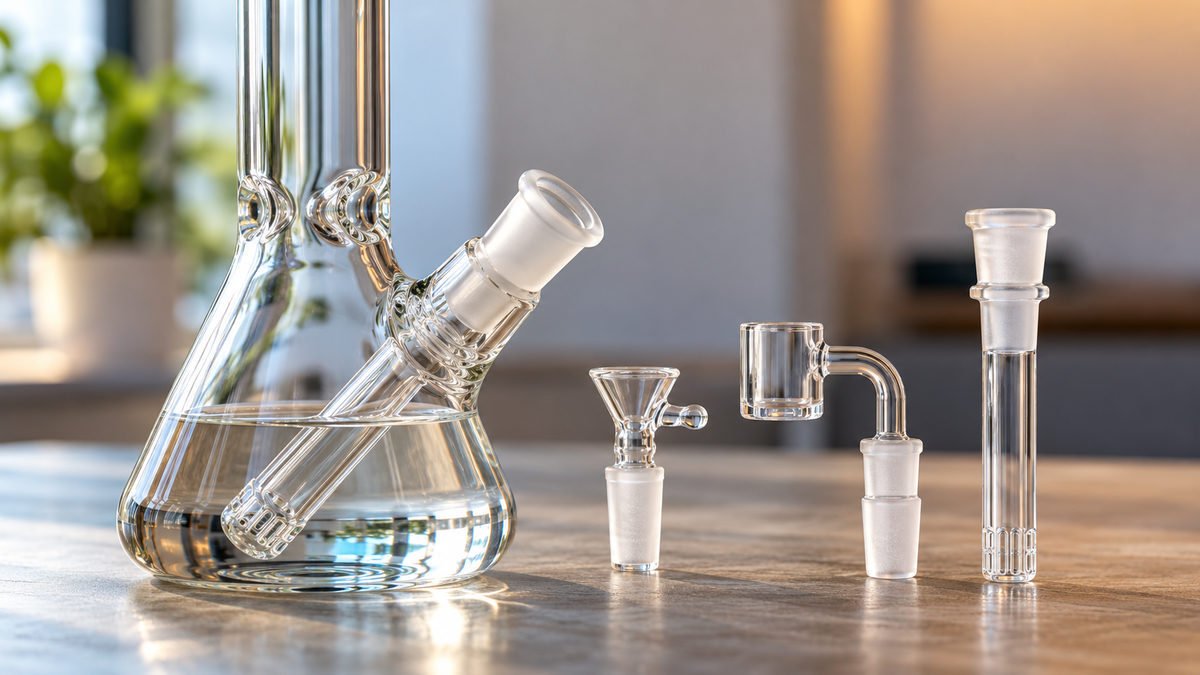
Bought a bowl, banger, or downstem that almost fits your bong but will not seal correctly? Bong joint sizes explained clearly can save you from leaks, unstable glassware, and wasted money.
Glass accessories use specific diameters, genders, angles, and insertion depths. Therefore, a visually similar part may still be incompatible. This guide compares 10mm, 14mm, and 18mm joints, explains how to measure your glass, and helps you choose compatible bowls, bangers, downstems, ash catchers, and adapters.
Bong Joint Sizes Explained: What the Joint Does
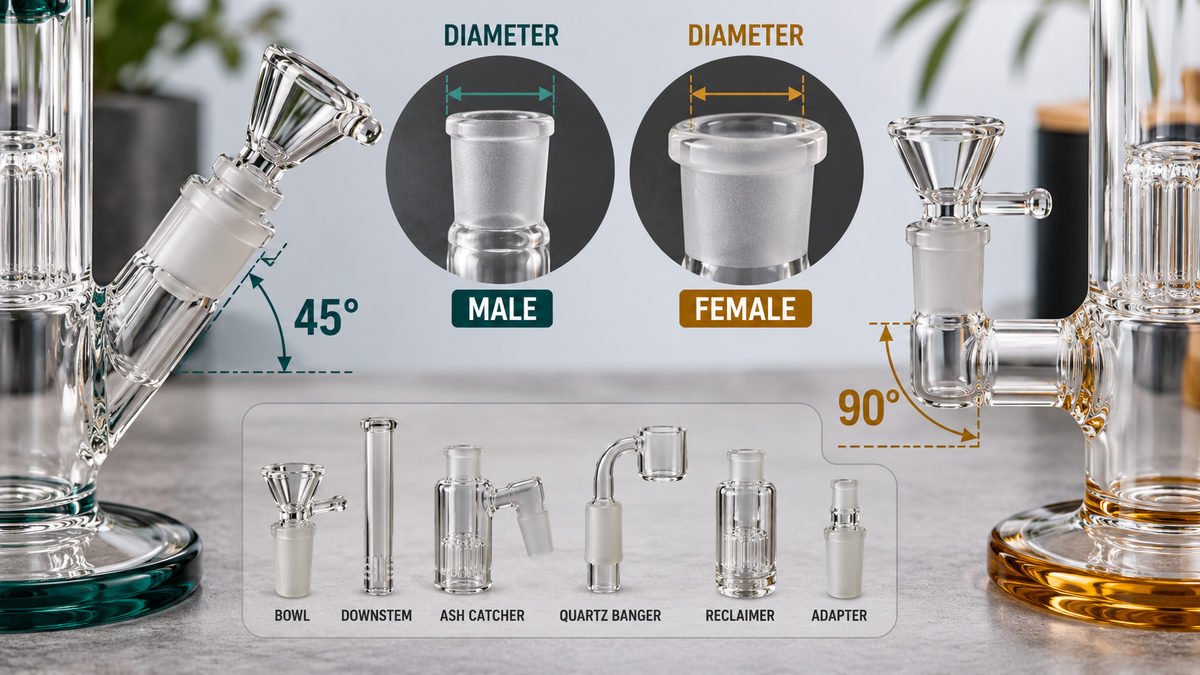
A bong joint is the glass connection point between the bong and an accessory. It may connect to a bowl, downstem, ash catcher, quartz banger, reclaimer, or adapter.
The joint creates the physical connection and helps maintain an airtight seal. Additionally, it supports the accessory and directs airflow through the bong’s chamber.
When the joint fits correctly, the accessory sits securely without wobbling. However, an incorrect fit can cause air leaks, poor airflow, unstable glass, or stress around the connection.
Three specifications matter most: diameter, gender, and angle. You must match all three before buying replacement glass.
Joint diameter
Joint diameter describes the nominal size of the connection. The most common sizes are 10mm, 14mm, and 18mm.
These measurements usually refer to the connection size rather than every visible glass surface. For example, a thick 14mm joint may look much larger externally.
Manufacturers may also use slightly different tolerances. Therefore, always check the product specifications when purchasing a replacement part.
Joint angle
Most bong joints use either a 45-degree or 90-degree configuration. The angle describes how the joint enters the bong body.
A 45-degree joint points diagonally away from the chamber. Meanwhile, a 90-degree joint enters horizontally or perpendicular to the main body.
Angle does not change the diameter. Instead, it affects accessory positioning, clearance, stability, and how the piece sits beside the bong.
For general background, you can read the Wikipedia overview of bongs. Accessory compatibility still depends on the exact glass specifications.
Bong Joint Size Chart: 10mm, 14mm, and 18mm Compared
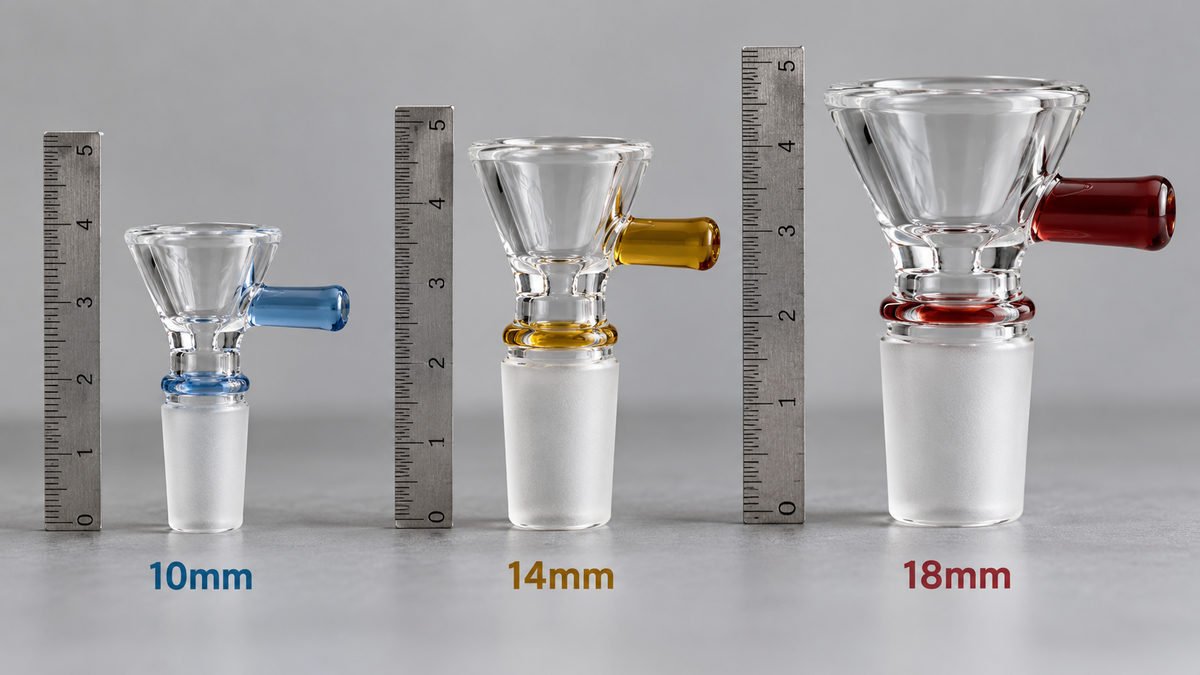
| Joint size | Typical use | Advantages | Limitations | Common accessories |
|---|---|---|---|---|
| 10mm | Mini bongs, compact rigs, and portable setups | Lightweight, compact, and space-efficient | Fewer accessories and a smaller connection | Small bowls, bangers, downstems, and adapters |
| 14mm | General-purpose bongs and dab rigs | Wide accessory availability and balanced performance | Larger than 10mm and smaller than heavy-duty 18mm glass | Bowls, bangers, ash catchers, reclaimers, and adapters |
| 18mm | Large bongs and high-volume setups | Robust connection and generous airflow potential | Heavier, larger, and less portable | Large bowls, bangers, downstems, and ash catchers |
10mm bong joints
A 10mm bong joint suits compact glass, mini rigs, and travel-oriented setups. Its smaller connection uses less glass and keeps the overall piece lightweight. Read our detailed 14mm vs 18mm bong joints comparison.
Additionally, 10mm accessories can create a neat, low-profile appearance. They work well when space, portability, and reduced setup weight matter most.
However, 10mm accessories may offer fewer choices than 14mm parts. The smaller opening may also feel more restricted with larger bowls or high-volume setups.
14mm bong joints
A 14mm bong joint is the most widely used general-purpose option. It offers broad compatibility across bowls, bangers, ash catchers, downstems, and adapters.
For many users, 14mm provides a practical balance between portability, airflow, glass strength, and accessory availability. It also makes replacement parts easier to find.
Therefore, 14mm is often the simplest starting point for a standard bong or dab rig. Still, you must confirm the gender and angle before ordering.
18mm bong joints
An 18mm bong joint suits larger bongs and setups designed for higher-volume draws. Its wider connection creates a robust interface between the bong and accessory.
Moreover, larger 18mm bowls can suit users who prefer longer sessions or a more substantial setup. The wider glass profile may also feel sturdier during handling.
On the other hand, 18mm glass usually adds weight and reduces portability. Accessory selection can also be narrower than the 14mm market.
14mm vs 18mm bong performance
An 18mm connection can support greater airflow potential than a 14mm connection. However, joint size alone does not determine the draw experience.
Percolator design, bowl restriction, water level, downstem length, and personal technique often have a stronger effect. Therefore, a well-designed 14mm bong may feel smoother than a basic 18mm model.
Joint size can influence smoke or vapour volume, but it does not guarantee a particular result. Consider the complete glass design rather than focusing on diameter alone.
Male and Female Bong Joints: How to Identify Each Type
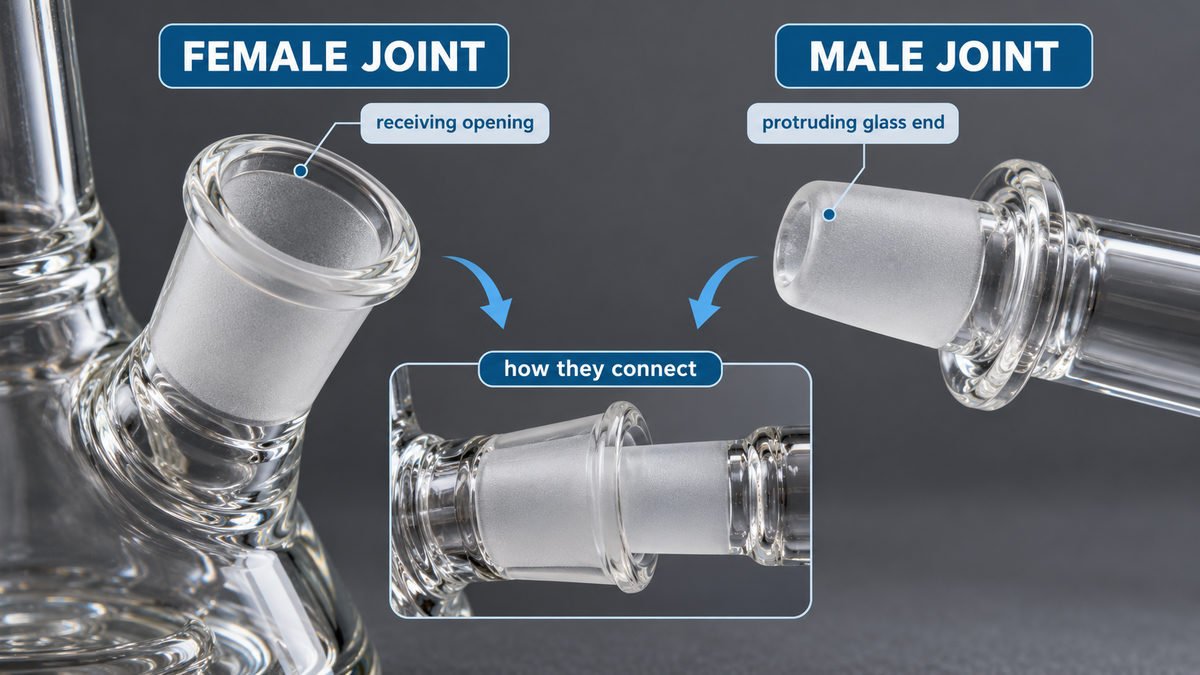
A female bong joint has a receiving opening. It accepts the inserted section of a male-ended accessory.
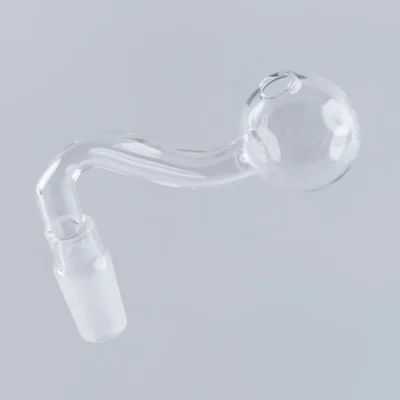
A male bong joint has a protruding glass end. That section slides into a matching female opening to create the connection.
Many bong bowls and bangers use male joints. Meanwhile, bong bodies, ash catchers, and some adapters commonly use female connections.
However, manufacturers use different designs, so exceptions exist. Never rely on the accessory name alone.
Identifying joint gender visually
Look for a visible opening or a protruding glass tube. A receiving socket usually indicates a female joint, while an inserted tube indicates a male joint.
Additionally, inspect the existing bowl or downstem without forcing it into another piece. You can often identify gender by comparing the parts side by side.
Do not test an uncertain accessory by pushing it into the joint. Even slight pressure can chip the rim or create a hairline crack.
The basic compatibility rule
The accessory’s gender must complement the bong’s receiving joint. A male accessory needs a matching female socket, while a female accessory needs a matching male connection.
Diameter and angle must also match. A 14mm male accessory will not properly fit a 10mm female joint.
Likewise, a 45-degree accessory may sit awkwardly or strike the bong when used with a 90-degree joint. Always check the complete specification.
Remember that a removable downstem has more than one connection. Its lower end sits inside the bong, while its upper joint receives the bowl.
Therefore, do not confuse the downstem’s bong-side joint with the bowl joint at the top. They may use different diameters or genders.
How to Measure Bong Joint Size and Angle Correctly
Start by inspecting the bong, downstem, or existing accessory in good lighting. Remove resin and buildup before taking measurements. Measure downstems the same way; see our bong downstem guide.
Next, identify the actual connection area. Avoid measuring decorative glass, thick collars, or sections that never enter the matching joint.
Measuring an open female joint
Use digital calipers to measure the inside diameter at the opening. Place the caliper jaws gently across the internal edges.
Compare the reading with the nominal sizes of 10mm, 14mm, or 18mm. Small differences can occur because glass thickness and manufacturing tolerances vary.
Do not squeeze the calipers tightly against the glass. Excessive pressure can damage a fragile rim.
Measuring a male joint
Measure the outside diameter of the section that enters the female joint. Avoid measuring the thicker decorative glass above that section.
Take measurements near the usable insertion area. If the joint tapers, record the narrowest and widest points.
Additionally, measure the usable insertion depth when ordering a downstem or specialised adapter. A correct diameter may still fail if the part sits too deeply.
Identifying the angle
Observe how the joint enters the bong body. A diagonal connection usually indicates approximately 45 degrees.
A connection entering straight across the body usually indicates approximately 90 degrees. Use the existing accessory as a reference when the angle is difficult to see.
A ruler can provide a rough estimate, but digital calipers offer better precision. For difficult measurements, a well-fitting bowl or downstem provides a useful comparison.
- Record the nominal diameter.
- Record whether the joint is male or female.
- Record the approximate angle.
- Measure usable insertion depth.
- Check the joint for chips, cracks, and buildup.
Do not measure through resin buildup. Also, do not assume that two accessories look compatible because their visible glass appears similar.
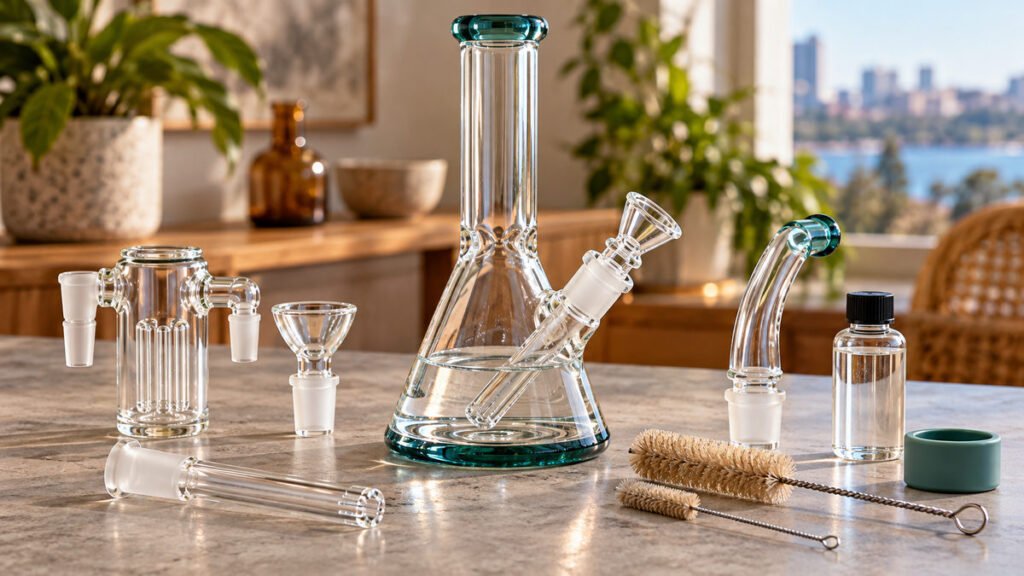
Bong Accessory Compatibility: Bowls, Downstems, Bangers, and Adapters
Accessory compatibility requires more than matching a number. You must match diameter, gender, angle, insertion depth, and surrounding clearance. See which bowls fit in bong bowls explained.
Bong bowls
Most bong bowls use a male joint that inserts into a female downstem or bong connection. Match the bowl to the receiving joint’s nominal diameter.
For example, a 14mm male bowl suits a 14mm female joint. It will not form a proper seal inside a 10mm or 18mm opening.
Also check the bowl’s outer profile. A large bowl may technically fit but still collide with a nearby handle, mouthpiece, or percolator.
Downstems
A downstem has two functional ends. The lower end sits inside the bong and directs airflow through the water.
The upper end receives the bowl and may use a different joint specification. Therefore, measure both ends before buying a replacement downstem.
Removable downstems require accurate length and diameter measurements. A stem that sits too high may not submerge correctly, while one that sits too low may touch the base.
Fixed downstems cannot usually be replaced without specialist glasswork. In that case, focus on matching the bowl to the fixed joint.
Ash catchers and reclaimers
An ash catcher connects between the bong and the bowl. Its bong-side joint must match the bong’s receiving joint.
Its upper connection must then match the bowl or banger. Additionally, the ash catcher’s angle must provide enough clearance around the bong base.
Reclaimers follow the same principle. Check both connection points, overall height, and the position of the collection chamber.
Banger joint sizes
Quartz bangers commonly come in 10mm, 14mm, and 18mm options. You must match diameter, gender, and angle before buying.
A banger may fit the diameter but still point in the wrong direction. That mistake can place the heated section too close to the bong or table.
Most bangers use a male joint, although specialised designs vary. Always check the seller’s technical specifications.
Adapters and common fit failures
14mm and 18mm accessories are not directly interchangeable because their diameters differ. A correctly sized adapter can bridge the difference.
However, adapters add height and may alter airflow. They can also affect balance, create clearance problems, or place extra pressure on the bong joint.
Both ends of the adapter must match the connected parts. For example, a female-to-male adapter may be required for one setup, while another needs male-to-male connections.
An accessory may fail to fit for several reasons:
- The nominal size is incorrect.
- The gender does not complement the bong.
- The angle creates a clearance problem.
- Glass thickness prevents full insertion.
- Resin buildup reduces the opening.
- The joint has chips or deformation.
- The product listing gives incomplete measurements.
Choosing the Right Joint Size and Avoiding Common Fit Problems
For many beginners, 14mm offers the easiest starting point. It provides broad accessory availability and a balanced combination of airflow, portability, and stability. Once you know your size, browse bong replacement parts.
Choose 10mm when you prefer compact glass, lower weight, or a travel-oriented setup. This size works well for mini bongs and smaller rigs.
Choose 18mm when you use a larger bong, prefer heavier bowls, or want a more robust connection. The trade-off involves extra weight, size, and reduced portability.
Cleaning and handling
Clean the joint regularly to remove resin and maintain a smooth connection. Buildup can make accessories feel tight or create an uneven seal.
Support the accessory near the joint when lifting or moving the bong. Avoid sideways pressure, twisting force, and sudden impacts.
Inspect the glass for chips, cloudy stress marks, or hairline cracks. Stop using damaged glass until you replace it safely.
Troubleshooting fit problems
- Loose accessory: Confirm the diameter and inspect the joint for wear or damage.
- Tight accessory: Clean buildup and check whether the part tapers incorrectly.
- Rocking bowl: Confirm the gender, angle, and insertion depth.
- Air leak: Inspect the rim for chips and check whether the joint fully seats.
- Stuck joint: Do not force it sideways. Use careful handling and seek specialist advice if necessary.
Before purchasing replacement glass, check diameter, gender, angle, and insertion depth. Product photos alone rarely provide enough information.
Local terminology and product availability can vary when shopping for bong accessories in Australia. Therefore, compare technical specifications rather than relying on category names.
Final buying checklist
- Measure the existing glass.
- Confirm the joint gender.
- Match the angle.
- Verify the accessory diameter.
- Check insertion depth.
- Confirm clearance around the bong.
- Buy from a seller with precise specifications.
Conclusion
The most common bong joint sizes are 10mm, 14mm, and 18mm. However, correct compatibility also depends on gender, angle, insertion depth, clearance, and accessory design.
Measure your existing glass before ordering a bowl, banger, downstem, ash catcher, or adapter. Then compare every measurement with the product specifications.
Ready to browse compatible glass and accessories? Visit Sweet Puff Australia to explore options and compare products carefully before purchasing.


Comment (1)
[…] Compatibility depends on more than a part’s appearance. You must match the joint size, connection type, joint angle, insertion depth, and component dimensions. Furthermore, the replacement must leave enough clearance inside the bong. Start with our guide to bong joint sizes. […]